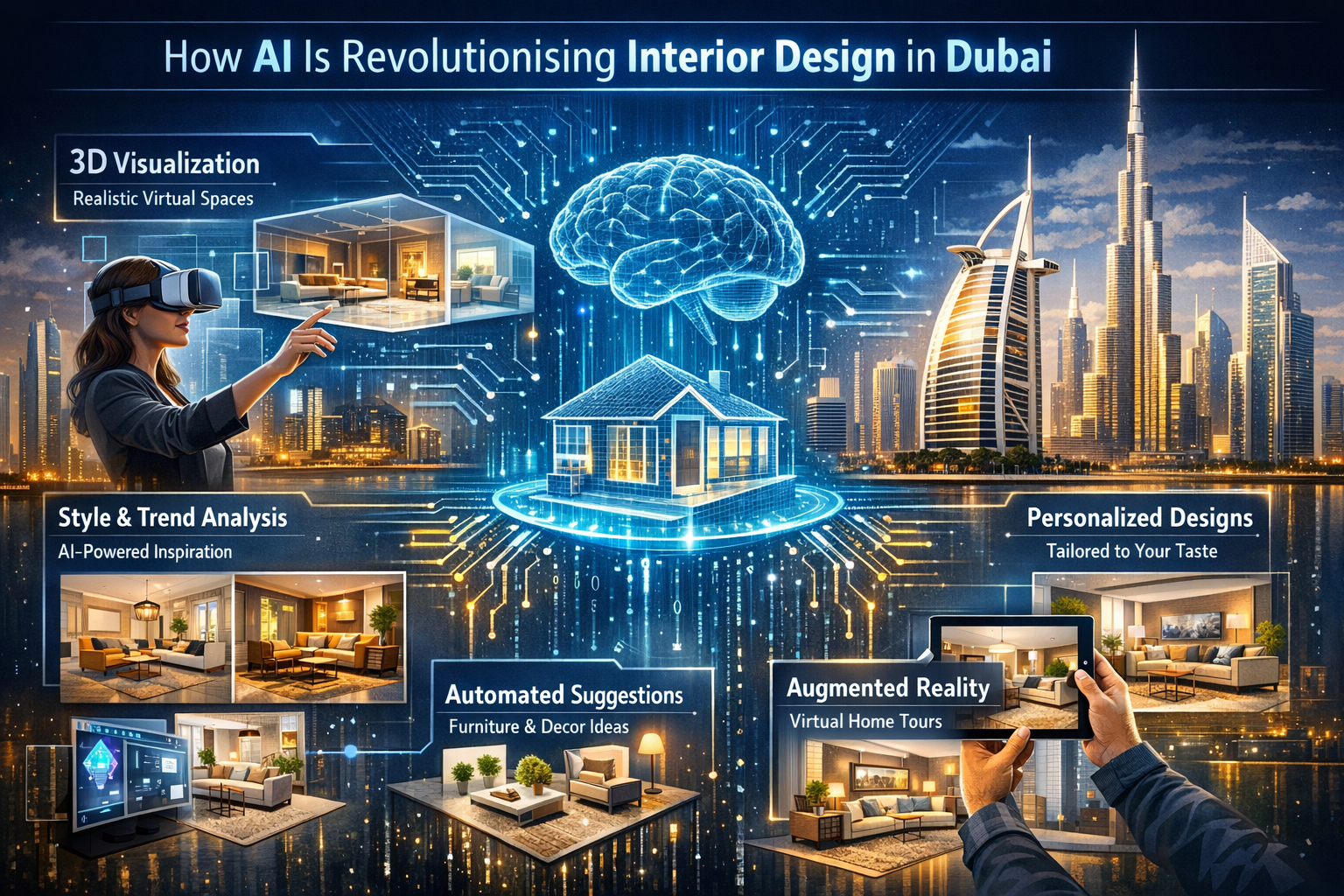
Artificial intelligence (AI) is reshaping every part of the design industry, and Dubai’s fast‑evolving interior design sector is no exception. AI has moved from an experimental concept to a practical design companion; by 2026 it plays a pivotal role in planning, visualisation, space optimisation and sustainability. The following sections explore how generative AI, predictive analytics and specialized design tools are revolutionising interior design in Dubai and what this means for clients and professionals.
Rapid concept generation and visualisation
Traditional interior design required designers to spend hours modelling layouts and rendering images. AI tools dramatically shorten this cycle. A 2025 article on Vista by Lara – a UAE‑based AI marketing agency – notes that designers once spent hours developing 3D concepts, but AI now generates these visualisations in seconds, cutting costs and giving clients more creative control. Vista Vision GPT, a tool trained specifically for interior design and architecture workflows, understands textures, furniture styles, lighting and cultural aesthetics relevant to Dubai’s market. Users can upload a room layout, describe a theme such as “Modern Majlis with gold accents” and instantly receive style boards, colour palettes and 3‑D visualisations.
Generative AI also personalises design options. According to Design Middle East, AI can analyse a user’s preferences and spatial limitations, suggesting furniture layouts, colour palettes and decorative elements that match the client’s style. Virtual staging tools generate realistic, furnished images of spaces before any physical setup, making it easier for clients to visualise the final result. These rapid visualisations enable designers to present multiple ideas early in the design process and refine them with client feedback.
Optimising layouts and space planning
AI isn’t just about pretty visuals; it helps designers create more functional spaces. Generative AI tools can analyse room layouts and recommend the best ways to arrange furniture, position lighting and incorporate storage solutions. Modern floor‑plan generators like Spacemaker, TestFit and Revit AI plugins instantly create multiple layout alternatives based on room dimensions, zoning laws, sunlight orientation and even the client’s lifestyle. Architects and designers can compare these alternatives, evaluate functionality and visualise how each design performs, leading to smarter decisions and faster execution.
Ramirro Ceramica’s 2025 analysis describes how AI simulation software predicts sunlight patterns, airflow and energy use within a space. These insights help designers choose appropriate materials and optimise comfort. Predictive analytics can also estimate the quantities of materials required and identify potential cost overruns before construction begins. This foresight reduces waste and helps manage budgets efficiently, a crucial advantage for luxury renovations and large commercial projects in Dubai.
Material selection and sustainability
Sustainability is a growing priority in the UAE. AI‑enabled tools assist designers in selecting eco‑friendly materials and energy‑efficient design solutions. AI platforms maintain extensive digital libraries of tiles, stones and ceramics, allowing designers and clients to “try before you install” by previewing how materials will look in an actual space. By suggesting textures, colours and finishes that work well together, AI reduces guesswork and ensures cohesive design choices.
Madbrick Studio, a Dubai‑based firm, notes that artificial intelligence plays a supporting role in planning, visualisation and precision. AI helps designers analyse space utilisation, predict lighting behaviour and simulate material combinations long before execution. However, the studio emphasises that AI should be viewed as an assistant, not a decision‑maker: design intuition, emotional understanding and cultural sensitivity still come from human designers. This balance between human creativity and machine‑driven optimisation is essential to avoid cookie‑cutter results and maintain cultural authenticity in Dubai’s diverse design landscape.
Personalized style prediction and customer empowerment
AI tools not only generate visuals but also learn a client’s aesthetic preferences. Style‑prediction engines analyse visual data from platforms such as Instagram and Pinterest to recommend colour palettes, furniture styles and surface textures that match the user’s taste. These recommendations help designers craft interiors that feel personal and culturally relevant.
AI also democratizes design by empowering homeowners to become co‑creators. Ramirro’s report describes how homeowners can upload photos of their rooms and experiment with different finishes and surfaces on their smartphones or computers. The AI system then provides personalised suggestions for layouts, lighting schemes and décor elements. This “try before you install” capability reduces uncertainty and regrets after installation and enables clients to make confident decisions early in the design process.
Parametric design and computational workflows
Generative AI is increasingly integrated into parametric and computational design workflows. Parametric architecture uses algorithms to create complex, optimised forms. Design Middle East explains that AI enhances these workflows by analysing spatial constraints, refining layouts for durability and running simulations to assess structural stability before construction. Once considered niche, parametric design has become a cornerstone of modern architecture; with AI’s support, it offers performance‑driven and sustainable solutions. Tools such as Autodesk’s Dreamcatcher and Spacemaker generate AI‑optimised designs based on user requirements; platforms like Midjourney and DALL·E allow rapid visualisation during early concept stages.
Market growth and economic potential
The adoption of AI in design is not just a trend; it represents a significant economic opportunity. Research cited by technology firm Achievion estimates that the global market for generative AI in design was US$412 million in 2022 and is projected to reach US$7.75 billion by 2032, representing a compound annual growth rate of 34.11 %. Achievion also notes that generative AI can transform interior design by making the process more accessible, efficient and personalised. These market dynamics are particularly relevant for Dubai, where property development and luxury interiors are major industries.
Dubai’s unique context and adoption
Dubai’s design scene is known for its luxury, innovation and cultural diversity. AI tools tailored for the UAE, such as Vista Vision GPT, are trained to understand local textures, furniture styles and cultural aesthetics. The UAE design community is actively adopting AI‑powered tools to reimagine how spaces are created. These tools help designers deliver visual presentations, mood boards and virtual tours at record speed, giving them a competitive edge in a market where clients expect bespoke, high‑end experiences.
Furthermore, as emphasised by Madbrick Studio, AI should enhance rather than replace human creativity. In Dubai, where design often blends modernity with cultural heritage, human judgement is crucial to ensure that AI‑generated designs reflect local sensibilities and lifestyles. AI frees up designers to focus on storytelling, spatial experience and client relationships while handling repetitive tasks like drafting and rendering..
Limitations and ethical considerations
Despite its benefits, AI has limitations. Generative AI lacks emotional intelligence and cultural sensitivity; its output depends heavily on the quality of the data used to train it. Biased or poor data can lead to uninspired or impractical designs. Ethical issues also arise regarding ownership of AI‑generated content—questions of whether the architect or the software owns the design remain unresolved. As AI becomes more integrated into design workflows, establishing guidelines for credit, copyright and accountability will be essential.
The road ahead
AI is poised to become an indispensable tool for interior designers in Dubai. It accelerates the design process, enhances precision, optimises space planning and encourages sustainable choices. Tools like Vista Vision GPT and Spacemaker show how AI can be tailored to local markets and cultural aesthetics, while generative platforms such as Midjourney and DALL·E open new avenues for creative exploration. However, the most successful designs will continue to be those where human intuition guides AI‑driven recommendations.
As Dubai prepares for future events like Expo 2030 and continues to expand its luxury real‑estate portfolio, the fusion of AI and interior design will play a central role in shaping elegant, efficient and culturally resonant spaces. Firms that embrace AI thoughtfully—seeing it as a collaborator rather than a replacement—will lead the next chapter of design innovation in the city.