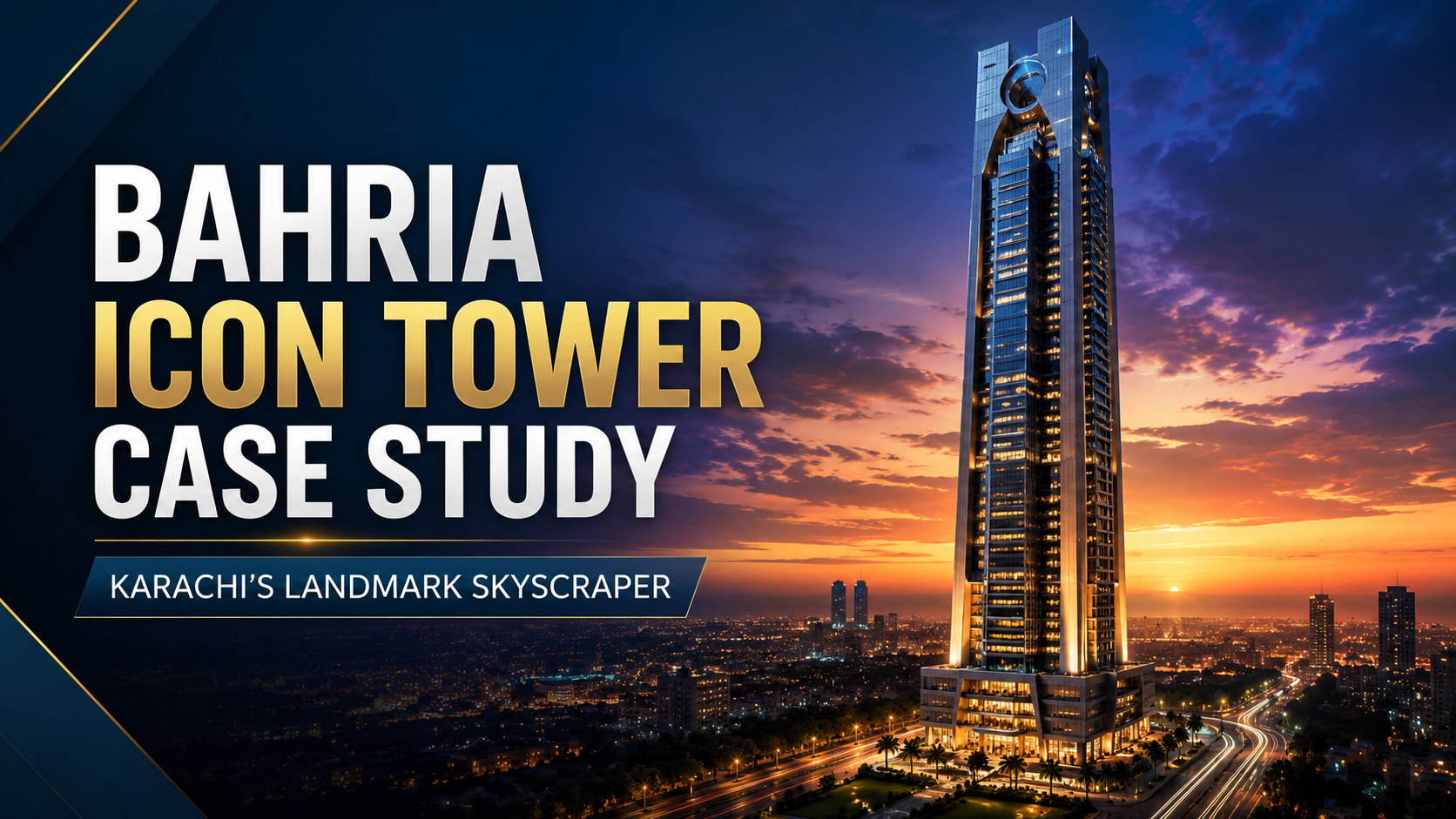
Bahria Icon Tower, also known as Bahria Town ICON, is one of the most important high-rise developments in Pakistan. Located on Shahrah-e-Firdousi, Clifton, Karachi, the tower stands as a major example of modern vertical development in the country. According to The Skyscraper Center, Bahria Town ICON has an architectural height of 273 metres / 896 feet, with 62 floors above ground and 7 floors below ground. It is widely recognised as Pakistan’s tallest building.
Project Overview
Bahria Icon Tower was planned as a mixed-use high-rise development, not just a single-purpose residential or office tower. The project combines apartments, corporate offices, restaurants, retail space, parking, and lifestyle facilities in one vertical structure. The official Bahria Town page describes it as a 62-storey vertical landmark with apartments, corporate offices, a 42-storey residential tower, concierge services, a shopping mall, and panoramic views of Karachi and the ocean.
Quick Project Facts
DetailInformationProject NameBahria Town ICON / Bahria Icon TowerLocationClifton, Karachi, PakistanOwnerBahria TownDeveloperBahria TownFounder / Chairman of Bahria TownMalik Riaz HussainArchitectArshad Shahid AbdullahMain Contractor / BuilderHabib Rafiq Pvt. LtdProject ManagerAAA-PartnershipStructural EngineerWSP / Parsons Brinckerhoff and Beg AssociatesHeight273m / 896ftFloors62 above ground, 7 below groundParking SpacesAround 1,700Elevators16Building TypeMixed-use high-rise
The Skyscraper Center lists Bahria Town as the owner, Arshad Shahid Abdullah as architect, AAA-Partnership as project manager, Habib Rafiq Pvt. Ltd as main contractor, and WSP / Parsons Brinckerhoff with Beg Associates as structural engineering contributors.
Background and Vision
The vision behind Bahria Icon Tower was to create a landmark that could change the image of high-rise development in Pakistan. Karachi is the country’s largest commercial city, and Clifton is one of its most premium real estate zones. A project of this scale was not only about building height; it was about creating a new benchmark for luxury living, corporate space, retail activity, and skyline identity.
Bahria Town’s official description presents the project as a “pioneer of modern high-rise buildings in Pakistan” and highlights the role of architects, designers, engineers, developers, and builders in bringing the 62-storey structure to life. The official page also mentions over 3,300,000 sq. ft. of covered area, showing the scale of the development.
Owner and Developer
The project owner and developer is Bahria Town, one of Pakistan’s largest private real estate development groups. Public profiles describe Malik Riaz Hussain as the founder and chairman of Bahria Town. For this case study, the building ownership is treated as Bahria Town because that is how the project is listed in tall-building records.
Builder, Architect, and Project Team
A project of this height needs a strong technical team. The architecture was led by Arshad Shahid Abdullah, while Habib Rafiq Pvt. Ltd is listed as the main contractor. The Skyscraper Center also names AAA-Partnership as project manager and mentions WSP / Parsons Brinckerhoff, Beg Associates, RWDI, ITnIS Consulting, and Cellpor Building Solutions among the companies involved in engineering, wind consultation, security consultation, vertical transportation, and material supply.
This team structure shows that Bahria Icon Tower was not a simple local building project. It required specialised planning in structural design, wind behaviour, vertical transportation, security systems, parking, façade materials, and long-term building operations.
Design Concept
The main design concept of Bahria Icon Tower is vertical mixed-use luxury. Instead of spreading functions across a large horizontal site, the project stacks them vertically. Retail and commercial activities are placed in lower areas, while offices, apartments, restaurants, amenities, and viewing spaces are organised across upper levels.
AAA Projects describes the project as two towers identical up to eight floors, including seven basements for parking and one ground floor. Tower 1 includes 62 levels for office, apartments, restaurant, and retail space, while Tower 2 includes 42 floors for retail, apartments, and special amenities.
This planning model is important because land in premium urban areas like Clifton is expensive and limited. Vertical design helps developers use land efficiently while creating premium value through views, height, and brand identity.
Location Strategy
The building stands in Clifton, Karachi, one of the city’s most recognised urban districts. Clifton already has strong commercial value, residential demand, public activity, retail movement, and coastal visibility. Bahria Town’s official page highlights the project’s location on Shahrah-e-Firdousi and positions it as a prime site with city and ocean views.
The location gives the tower three major advantages. First, it creates strong visibility for the project. Second, it connects the building with a premium lifestyle market. Third, it allows the tower to become part of Karachi’s skyline identity.
Construction and Engineering Importance
Building a 273-metre tower in Karachi requires advanced planning. The structure must respond to wind pressure, foundation loads, traffic access, fire safety, elevators, water systems, energy systems, drainage, parking, and long-term maintenance. The Skyscraper Center lists the building’s primary structural material as all-concrete, which means the project depends heavily on reinforced concrete engineering rather than a typical low-rise construction method.
Another important engineering factor is vertical movement. With 62 floors and multiple uses, elevator planning becomes a major part of the user experience. The Skyscraper Center lists 16 elevators, which supports the building’s need for residential, office, commercial, and service circulation.
Urban Impact
Bahria Icon Tower changed the visual identity of Karachi’s skyline. Before projects like this, Pakistan’s urban development was mostly associated with low-rise and mid-rise buildings. Bahria Icon Tower proved that Pakistan could host a true skyscraper-scale project with mixed-use programming and international-style planning.
Its biggest impacts include:
- A stronger high-rise development trend in Pakistan
- New confidence in luxury vertical real estate
- A visual landmark for Karachi
- Higher expectations from architects, developers, and investors
- More discussion around infrastructure and urban planning
However, every mega project also creates pressure on the city around it.
Challenges and Public Concerns
A professional case study should not only discuss the positive side. Bahria Icon Tower was also linked with public concerns around traffic, environmental impact, and heritage protection. In 2014, Dawn reported objections during a SEPA hearing related to the Clifton high-rise and traffic project. Residents, community representatives, and organisations raised concerns about traffic, environmental issues, drainage, and stakeholder consultation.
Dawn also reported that the Sindh High Court issued a stay order on the execution of SEPA approval for the Clifton traffic project, with concerns linked to the construction of underpasses and a flyover near heritage and religious sites in Clifton.
This shows a major lesson: tall buildings cannot be studied only as architecture. They must also be studied as part of the city. Roads, drainage, parking, pedestrian movement, public consultation, heritage protection, and environmental impact are all part of responsible high-rise development.
Business and Real Estate Value
From a business point of view, Bahria Icon Tower is a strong example of how mixed-use development creates multiple revenue streams. The project can generate value through luxury apartments, corporate offices, retail space, restaurants, parking, branding, and long-term asset appreciation.
The “Pakistan’s tallest building” positioning also became a powerful marketing tool. Height itself became part of the product. For investors, buyers, and corporate users, the tower offers status, visibility, location, and exclusivity.
Key Lessons from Bahria Icon Tower
Bahria Icon Tower offers several lessons for future architecture and real estate projects in Pakistan.
First, high-rise buildings need complete urban planning. A tall tower is not only a structure; it changes traffic flow, utility demand, pedestrian movement, and public pressure.
Second, mixed-use planning is powerful when done correctly. By combining residential, office, retail, and leisure spaces, developers can create a more active and valuable project.
Third, technical teams matter. Architects, engineers, contractors, consultants, and project managers must work together from the start.
Fourth, public concerns should be handled early. Large projects need environmental studies, traffic studies, community engagement, and transparent approvals.
Fifth, design should balance beauty and usability. A landmark building must look impressive, but it must also function smoothly for everyday users.
SWOT Analysis
StrengthsWeaknessesPakistan’s tallest buildingHigh infrastructure pressurePrime Clifton locationTraffic concernsMixed-use planningHigh maintenance requirementsStrong brand valueComplex operations
OpportunitiesThreatsMore high-rise projects in PakistanRegulatory delaysLuxury real estate demandMarket slowdownCorporate office demandPublic objectionsUrban skyline identityEnvironmental concerns
Role of Zara Design Studio in Future Projects
Bahria Icon Tower is a strong example for developers, investors, and architecture firms who want to understand large-scale design, mixed-use planning, and urban impact. For new residential, commercial, hospitality, landscape, or urban design projects, Zara Design Studio can bring a more human-centred and context-driven design approach.
Zara Design Studio works across architecture, interior design, outerscape, and urban design. Its website describes architecture as the physical manifestation of space, interiors as layered with natural earthy materials, outerscape as outdoor areas shaped by foliage, water, and materiality, and urban design as inclusive public-realm planning.
The studio also highlights 320+ projects, work across 7+ countries, and around 10+ years of experience, with projects in Pakistan, UAE, USA, Canada, Germany, UK, and the Netherlands.
Zara Design Studio Services to Add in This Blog
For readers planning a similar project, Zara Design Studio can be mentioned for:
- Architecture design
- Commercial architecture
- Interior design
- Commercial interior design
- Residential design
- Landscape / outerscape design
- Urban design and public realm planning
- Hospitality and retail space design
- Office and corporate space planning
- Concept development and design consultancy
Clean Internal Links to Add
Use these clean links inside the blog:
- Zara Design Studio Home: https://www.zaradesignstudio.com/
- Architecture Services: https://www.zaradesignstudio.com/architecture-commercial
- Interior Design Services: https://www.zaradesignstudio.com/interior-commercial
- Landscape Design: https://www.zaradesignstudio.com/landscape-design
- Urban Design: https://www.zaradesignstudio.com/urban
- Contact Page: https://www.zaradesignstudio.com/contact
- Commercial Architecture Project Example: https://www.zaradesignstudio.com/artchitecture-commercial/s-sons-factory
- Interior Project Example: https://www.zaradesignstudio.com/interior-commercial/luna
Conclusion
Bahria Icon Tower is more than Pakistan’s tallest building. It is a case study in ambition, high-rise engineering, mixed-use real estate, luxury positioning, and urban transformation. The project shows how architecture can change a skyline and create a new benchmark for future development. At the same time, it also teaches that major buildings must be planned with traffic, environment, public access, heritage, and long-term city impact in mind.
For developers and investors planning future high-rise, commercial, residential, or mixed-use projects, Bahria Icon Tower provides an important lesson: iconic design must work together with smart planning. This is where professional design teams like Zara Design Studio can help create spaces that are not only visually strong but also functional, sustainable, and connected to human experience.
FAQs
1. Which is the tallest building in Pakistan?
Bahria Icon Tower, also known as Bahria Town ICON, is widely recognised as Pakistan’s tallest building, with a height of 273 metres / 896 feet.
2. Who owns Bahria Icon Tower?
The building is listed as owned by Bahria Town.
3. Who was the architect of Bahria Icon Tower?
The Skyscraper Center lists Arshad Shahid Abdullah as the architect of Bahria Town ICON.
4. Who was the main contractor or builder?
The main contractor listed for Bahria Town ICON is Habib Rafiq Pvt. Ltd.
5. What can future projects learn from Bahria Icon Tower?
Future projects can learn the importance of mixed-use planning, strong engineering, urban impact studies, public consultation, traffic planning, and long-term building management.