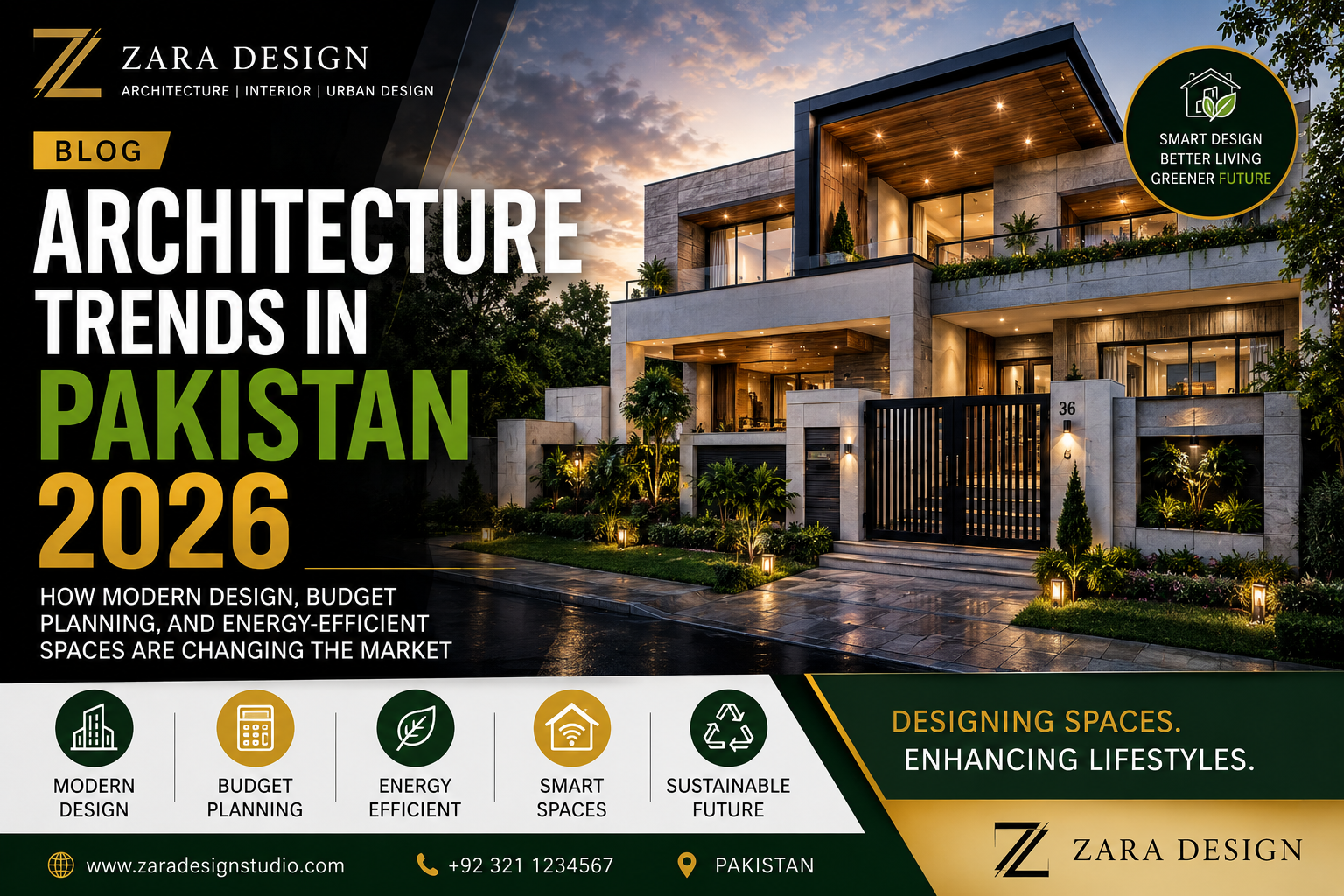
Architecture in Pakistan is changing fast in 2026. Clients are no longer looking only for attractive elevations or luxury interiors. They want spaces that look modern, work practically, stay within budget, and reduce long-term living costs. Whether it is a 5 marla house, a 10 marla residence, a luxury villa, an office, a café, or a commercial building, people now expect architecture to solve real lifestyle problems.
The Pakistani market is moving toward modern design, smart space planning, energy efficiency, cost control, and complete design-to-execution solutions. Rising energy concerns, changing family lifestyles, construction cost pressure, and the popularity of solar-ready homes are all shaping the way architects design spaces today.
For firms like Zara Design, this shift creates a strong opportunity to offer architecture, interior design, outerscape, and urban design services that match modern Pakistani needs. Zara Design Studio works across architecture, interior, outerscape, and urban projects, with a focus on contextually relevant and customized design solutions.
1. Modern Minimal Architecture Is Becoming More Popular
One of the biggest architecture trends in Pakistan in 2026 is modern minimal design. Clients are moving away from overly heavy façades, unnecessary decoration, and complicated layouts. Instead, they prefer clean lines, open spaces, neutral colors, large windows, natural materials, and elegant details.
Modern Pakistani homes now focus on comfort and simplicity. A good design does not need to look overloaded. It should feel spacious, bright, and easy to maintain. This is why minimalist elevations, straight forms, glass details, textured walls, and warm lighting are becoming common in cities like Islamabad, Lahore, Karachi, Faisalabad, Peshawar, and Rawalpindi.
For residential projects, modern architecture also helps improve functionality. Families want open lounges, practical kitchens, attached bathrooms, better storage, laundry spaces, prayer areas, home offices, and outdoor corners. A beautiful house is important, but a useful house is even more valuable.
Zara Design can help clients achieve this balance by creating homes that are visually modern but also planned around lifestyle, privacy, climate, and daily comfort.
2. Budget Planning Is Now a Major Part of Architecture
In Pakistan, construction cost is one of the biggest concerns for clients. Many people start a project with excitement but later face problems because the design was not planned according to their budget. In 2026, clients expect architects to guide them about design choices, material selection, project scope, and cost-saving decisions before construction starts.
Construction cost in Pakistan can change due to material prices, labor rates, energy costs, city regulations, and finishing choices. Builders also note that per-square-foot costs are not fixed because these factors keep changing.
This is why budget-based architecture is becoming a strong trend. Clients want answers to questions like:
How much will the grey structure cost?
Which materials are durable but affordable?
Can we make the elevation beautiful without overspending?
Which areas should receive premium finishes?
How can we reduce waste during construction?
A smart architecture firm does not only create drawings. It helps the client understand where to spend and where to save. For example, instead of using expensive materials everywhere, the architect can use premium finishes only in focal areas such as the main entrance, drawing room wall, staircase, kitchen, or front façade.
This approach is especially useful for 5 marla, 10 marla, and 1 kanal homes where every square foot matters.
3. Energy-Efficient Spaces Are Becoming a Serious Need
Energy-efficient design is no longer just a luxury trend in Pakistan. It is becoming a practical need. Due to high electricity costs, power management issues, and hot weather conditions, people want homes and buildings that stay cooler, use less electricity, and support solar systems.
A good energy-efficient design includes:
Proper building orientation
Cross ventilation
Shaded windows
Insulated roofs
Courtyards
Double-height spaces where suitable
Natural daylight
Solar-ready roof planning
Energy-saving lighting
Heat-resistant materials
Pakistan is also seeing rapid rooftop solar adoption. Reuters reported that rooftop solar generation is expected to exceed daytime grid demand in some industrial hubs such as Lahore, Faisalabad, and Sialkot, driven by high tariffs and power outages.
Even with changing solar policies, solar-ready architecture remains important. In February 2026, Reuters reported that Pakistan’s power regulator reduced the price paid to rooftop solar users for selling electricity back to the grid. This means homeowners now need smarter solar planning, not just panel installation.
Architects should now plan roof space, inverter placement, battery area, wiring routes, shade-free panel zones, and energy load management from the beginning. This makes the house future-ready and avoids expensive changes later.
4. Climate-Responsive Design Is Becoming More Important
Pakistan’s major cities face heat, pollution, dense construction, and reduced green spaces. This is directly affecting architecture. Buildings that ignore climate become uncomfortable and expensive to maintain.
A climate resilience study connected with Pakistan’s Ministry of Climate Change found that built-up and barren land showed higher land surface temperatures, while vegetation and water bodies showed lower temperatures. The study also reported temperature increases over two decades in cities including Lahore, Multan, Islamabad, and Muzaffarabad.
This makes climate-responsive architecture very important in Pakistan. Architects need to think about shade, air movement, green spaces, roof treatment, water features, landscape planning, and material performance.
A well-designed house should not depend only on air conditioning. It should naturally reduce heat gain. Deep windows, pergolas, screens, covered terraces, shaded balconies, plants, and internal courtyards can improve comfort. These features also add beauty and value to the property.
For commercial spaces, climate-responsive design can reduce operating costs and improve customer experience. A café, office, showroom, or clinic that feels comfortable naturally creates a better impression.
5. Interior Design Is Becoming Part of the Architecture Process
In the past, many clients hired an architect first and an interior designer later. Now, clients prefer a complete design solution where architecture and interior design work together from day one.
This is a smart trend because interior planning affects electrical points, ceiling heights, lighting, furniture layout, wall treatments, kitchen design, storage, and circulation. If interiors are planned late, the client may need to break walls, shift wiring, or make expensive changes.
In 2026, Pakistani clients want interiors that feel modern, warm, and practical. Popular interior trends include:
Warm neutral colors
Wood and stone textures
Soft lighting
Hidden storage
Open kitchens
Feature walls
Minimal furniture
Indoor plants
Natural materials
Smart lighting
Luxury but simple finishes
Zara Design Studio’s approach includes architecture and interior design as connected parts of the same spatial experience. Its official content highlights natural materials, warm tones, functional space planning, custom details, and a strong connection between architecture and interior design.
This type of complete design approach is useful for both residential and commercial clients who want a polished final result.
6. Commercial Architecture Is Growing in Pakistan
Commercial architecture is also changing in Pakistan. Businesses now understand that design affects customer trust, brand image, sales, and staff productivity. A good commercial space is not just a building; it is a business tool.
Restaurants, cafés, offices, clinics, salons, retail stores, academies, and showrooms need spaces that are functional and memorable. A well-designed commercial interior can improve customer flow, make products look premium, create social media value, and support brand identity.
For example, a café needs comfortable seating, lighting, customer movement, kitchen access, branding points, Instagram-friendly corners, and durable materials. A clinic needs privacy, hygiene, calm colors, waiting area comfort, and efficient circulation. An office needs meeting rooms, workstations, acoustic comfort, natural light, and flexible spaces.
Zara Design can support businesses by offering commercial architecture and interior design services that focus on branding, function, customer experience, and long-term usability.
7. 3D Visualization and Walkthroughs Are Now Essential
Pakistani clients want to see the final look before construction begins. This is why 3D visualization, realistic renders, walkthrough videos, and mood boards are now essential in architecture.
Many clients cannot fully understand 2D plans. But when they see a 3D exterior, interior render, or walkthrough, they can understand the design better and make decisions with confidence.
3D visualization helps with:
Understanding space
Choosing materials
Approving colors
Reviewing lighting
Avoiding mistakes
Reducing confusion
Improving client trust
For architecture firms, strong visual presentation also helps in marketing. Before-and-after posts, project reels, 3D renders, site progress videos, and final photography perform well on Instagram, Facebook, TikTok, and YouTube Shorts.
A firm that shows its process clearly can build more trust than a firm that only posts final images.
8. Smart Homes and Technology Integration Are Increasing
Smart home features are becoming popular in Pakistan, especially in new homes and luxury residences. Clients are interested in smart lighting, CCTV planning, automated gates, video doorbells, smart locks, security systems, solar monitoring, and energy-efficient appliances.
However, smart design should be planned during the architecture stage. If wiring, device locations, internet points, and security routes are not planned early, installation becomes messy later.
Technology integration is also useful in commercial spaces. Offices may need conference systems, access control, smart lighting, display screens, server spaces, and backup power planning. Retail stores may need CCTV, POS counters, display lighting, and digital signage.
Architecture in 2026 is not only about walls and rooms. It is about how people live, work, move, save energy, and use technology inside a space.
9. Outdoor Spaces and Landscape Design Are Becoming Valuable
Another strong trend in Pakistan is the importance of outdoor spaces. Even in smaller homes, clients want terraces, balconies, patios, rooftop sitting areas, small gardens, and green corners.
Outdoor spaces are not just decorative. They help with ventilation, relaxation, family gatherings, and temperature control. In cities where plots are becoming smaller and construction is dense, smart outdoor planning can make a home feel larger and healthier.
Landscape design is also important for farmhouses, villas, housing societies, commercial plazas, cafés, and public spaces. Greenery, shaded seating, walkways, water features, lighting, and outdoor furniture can change the entire experience of a project.
Zara Design’s service categories include outerscape and urban design, which makes it suitable for clients who want complete indoor and outdoor planning.
Why Choose Zara Design for Architecture and Interior Services?
Zara Design is a strong choice for clients who want modern, practical, and meaningful spaces. Instead of offering only drawings, Zara Design focuses on complete design thinking. The studio works across architecture, interiors, outerscape, and urban design, which helps create projects that feel complete and connected.
Whether you are planning a house in Pakistan, a luxury villa, a commercial space, a café, an office, or a landscape project, Zara Design can help with:
Architecture design
Interior design
Space planning
Commercial design
Residential design
3D visualization
Material concept
Modern façade design
Landscape and outdoor planning
Urban design solutions
The best part of working with a professional design firm is clarity. Clients can understand the design direction, budget priorities, functional planning, and final look before execution begins.
Conclusion
Architecture trends in Pakistan in 2026 are shaped by real needs. Clients want modern spaces, but they also want budget control, energy efficiency, climate comfort, smart planning, and long-term value. The market is moving away from decoration-only design and moving toward practical, lifestyle-based architecture.
Modern minimal homes, solar-ready planning, climate-responsive design, warm interiors, smart technology, commercial branding, outdoor spaces, and 3D visualization are now major parts of the architecture process.
For homeowners and businesses, the right architecture firm can make a major difference. A professional team like Zara Design can help turn ideas into spaces that are beautiful, functional, efficient, and future-ready.
In 2026, successful architecture in Pakistan is not about following trends blindly. It is about designing spaces that fit the client, respect the budget, respond to the climate, and remain valuable for years.
FAQs
1. What are the top architecture trends in Pakistan in 2026?
The top architecture trends in Pakistan include modern minimal design, energy-efficient homes, solar-ready planning, budget-based construction, smart interiors, natural materials, and climate-responsive architecture.
2. Why is budget planning important in architecture?
Budget planning helps clients avoid unexpected construction costs. It allows the architect to choose smart materials, control design complexity, and create a beautiful space within the client’s financial plan.
3. Are energy-efficient homes popular in Pakistan?
Yes, energy-efficient homes are becoming more popular because of hot weather, electricity costs, and solar adoption. Clients now prefer better ventilation, insulation, shaded windows, natural light, and solar-ready roof planning.
4. Does Zara Design provide architecture and interior design services?
Yes. Zara Design provides architecture, interior design, outerscape, and urban design services for residential and commercial projects.
5. Why should clients choose Zara Design?
Clients should choose Zara Design because the studio focuses on modern design, practical planning, customized spaces, interior detailing, and complete design solutions that match lifestyle, budget, and long-term value.